Signs Your Tree Needs to Be Removed Before It Costs You More
Trees are often the most valuable part of a home’s surroundings. They provide shade, beauty, and can even increase the value of your property. However, even the most majestic oak or maple can become a liability if it starts to fail. Many homeowners only think about a problematic tree after a storm causes damage. By then, the cost of removal or repairs is often much higher.
In this guide, we’ll cover the common signs that a tree may need to be removed and explain how identifying these problems in time avoids costly repairs and emergency removal.
Key Takeaways
- Dead branches, deep trunk cracks, mushrooms, and sudden leaning are major warning signs.
- Removing a hazardous tree early is usually much cheaper than emergency removal.
- Homeowners insurance typically does not pay for preventive tree removal.
- Annual tree inspections can identify problems before they become serious.
- An ISA Certified Arborist can recommend pruning, cabling, or removal based on the tree’s condition.
Why Waiting Can Cost You More
The price difference between a scheduled tree removal and an emergency call can be significant. When you schedule a removal on a calm, sunny day, you pay for the crew’s time and equipment. When a tree falls on your roof at midnight during a thunderstorm, you pay for “emergency” rates.
Emergency jobs require rapid dispatch, hazard pay for crews working in dangerous conditions, and often specialized equipment like cranes to lift trees off structures.
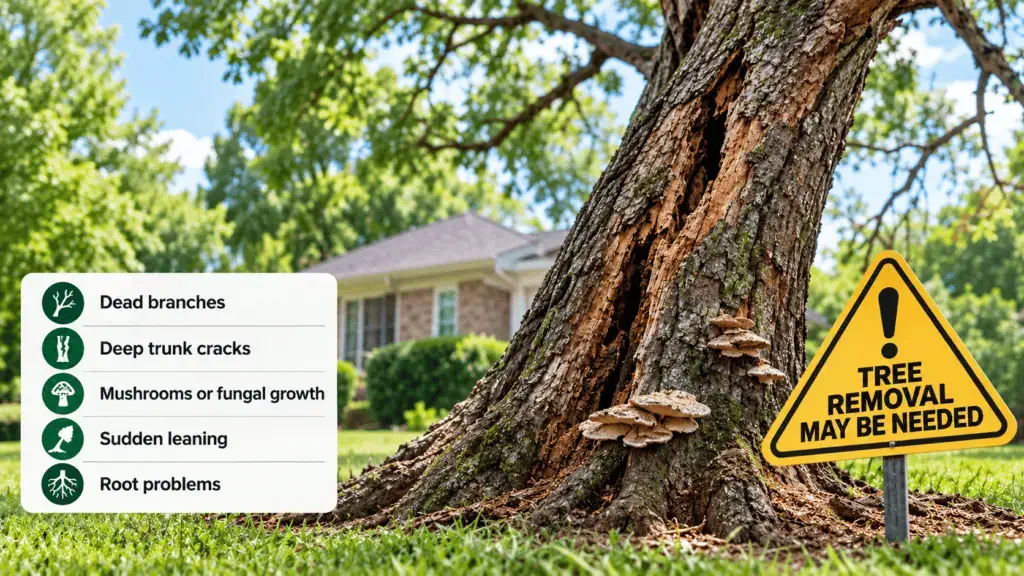
- Large dead branches over your roof or driveway
- Deep vertical cracks in the trunk
- Mushrooms growing around the base
- Tree suddenly leaning after a storm
- Soil lifting or mounding around the roots
- Large hollow cavities in the trunk
- Multiple branches growing in a tight “V” shape
Dead Wood and “Widowmakers”
- Vertical shear cracks are especially dangerous because they go entirely through the wood.
- If you notice two or more cracks in the same area, the tree is at high risk of breaking.
- Cracks that connect to other defects, like a hollow cavity, are extreme hazards.
Internal Decay and Fungal Growth
- Mushrooms or Conks: If you see shelf-like fungi or mushrooms growing on the trunk or around the base, this is a sign of internal rot.
- Hollow Sounds: If the trunk sounds hollow when you tap on it, decay has likely progressed significantly.
- Cavities: Large holes or cavities in the trunk are places where wood has already rotted away. If the shell of sound wood is less than one-third of the tree’s diameter, it is very unstable.
Root Problems and Soil Changes
- Soil Mounding: Look for soil that is rising or heaving on one side of the tree. This means the root plate is pulling out of the ground.
- Exposed or Damaged Roots: Construction near a tree, such as a new driveway or trenching, can damage critical anchor roots.
- Fungi at the Base: Just like the trunk, mushrooms at the root flare suggest the roots are rotting underground.
Sudden Leaning
- A sudden lean after a storm is an emergency.
- If the tree leans more than 15 to 40 degrees from vertical, it is much more likely to fail.
When to Call a Professional Immediately
- A tree leaning after a recent storm.
- Large dead limbs hanging over structures.
- Deep trunk cracks that continue to grow.
- Mushrooms or fungal growth at the base.
- Roots lifting from the ground.
- A tree touching or threatening power lines.
Cost Comparison Table (2025 Estimates)
Tree Size | Standard Removal Cost | Emergency Removal Cost | Potential Savings |
Small (<30 ft) | $300 – $700 | $600 – $1,200 | Up to $500 |
Medium (30-60 ft) | $700 – $1,200 | $1,100 – $2,200 | Up to $1,000 |
Large (60-80 ft) | $1,200 – $1,800 | $1,800 – $3,500 | Up to $1,700 |
XL (80+ ft) | $1,800 – $2,500+ | $2,800 – $5,000+ | Up to $2,500+ |
Learn more in our guide: How Much Does Tree Removal Cost in Alpharetta, GA? Complete 2026 Price Guide. Click Here
Annual Tree Inspection Guide
- Check the canopy for dead branches.
- Inspect the trunk for cracks and cavities.
- Look for mushrooms around the base.
- Watch for changes in the tree’s lean.
- Check exposed roots and surrounding soil.
- Schedule a professional inspection if anything looks unusual.
Proactive Steps to Save Your Budget
- Get a Risk Assessment: An ISA Certified Arborist can use tools like resistance drilling to check for rot inside the trunk without hurting the tree.
- Prune Early: Removing dead or heavy branches reduces the load on a tree, making it less likely to fall during a storm.
- Cabling and Bracing: For trees with weak unions or a slight lean, an arborist can install steel cables to provide extra support.
- Manage the Soil: Aerating compacted soil and adding mulch keeps roots healthy and strong.
- Relocate Outdoor Items: If a hazard is limited to one branch, you may be able to simply move items like play sets or picnic tables out of the way.
Conclusion
Concerned About a Tree on Your Property?